|
Nikhil Sobanbabu I'm an MTS intern at Amazon FAR, working with Carlo Sferrazza, Guanya Shi, and Rocky Duan. I received my master's in Electrical and Computer Engineering from Carnegie Mellon University in 2026, where I worked with Prof. Guanya Shi at the LeCAR Lab, with a focus on system identification for legged robots and policy adaptation for humanoid whole-body control. I also collaborated with CMU's Search-Based Planning Lab on multi-agent quadruped planning. I received my bachelor's in Electrical Engineering from IIT Madras. During that time, I worked at USC's Dynamic Robotics and Control Laboratory (DRCL) with Prof. Quan Nguyen on prior-guided reinforcement learning for agile legged robot control. I was also the team lead and electrical subsystem lead of Team Anveshak, IIT Madras's competitive Mars rover team, during 2022–2023. My research statement outlines the directions I wish to pursue in the future. Email / CV / Google Scholar / LinkedIn / GitHub / Twitter / X / Blog |

|
Research InterestsI am interested in enabling high-DoF robots to acquire contact-rich skills and adapt them for robust real-world deployment. In particular, my interests include learning-based control (agile whole-body control and loco-manipulation) and Real2Sim2Real (reliable simulation evaluations, large-scale sim-to-real transfer, and sample-efficient policy adaptation in the wild). |
News
- September 2026: FADA accepted to CoRL 2026! Code and a research timeline are now available.
- July 2026: RIO published at RSS 2026.
- 2026: Completed my Master's in ECE at Carnegie Mellon University.
- September 2025: Released HDMI, learning interactive humanoid whole-body control from human videos.
- August 2025: SPI-Active accepted to CoRL 2025 (Oral)🎉.
- July 2025: MAPF for Quadrupeds accepted to ICAPS 2025 (Demo Track)🎉.
- May 2025: Preferential OGMP accepted to IROS 2025🎉.
- April 2025: ASAP accepted to RSS 2025🎉.
- August 2024: Started my Masters in ECE at Carnegie Mellon University.
Publications
* Equal contribution.
|
FADA: Few-Shot Domain Adaptation via Dynamics Alignment for Humanoid Control
CoRL 2026 Angchen Xie*, Nikhil Sobanbabu*, Ishayu Shikhare, Alan Wang, Max Simchowitz, Guanya Shi Webpage / arXiv / Code / Research timeline |
|
|
RIO: Flexible Real-Time Robot I/O for Cross-Embodiment Robot Learning
RSS 2026 Pablo Ortega-Kral*, Eliot Xing*, Arthur Bucker, Vernon Luk, Junseo Kim, Owen Kwon, Angchen Xie, Nikhil Sobanbabu, Yifu Yuan, Megan Lee, Deepam Ameria, Bhaswanth Ayapilla, Jaycie Bussell, Guanya Shi, Jonathan Francis, Jean Oh Webpage / arXiv / Proceedings / Code |
|
|
|
Sampling-Based System Identification with Active Exploration for Legged Robot Sim2Real Learning
CoRL 2025 (Oral) (All Strong Accepts) Nikhil Sobanbabu*, Guanqi He*, Tairan He, Yuxiang Yang, Guanya Shi |
|
|
Preferenced Oracle Guided Multi-mode Policies for Dynamic Bipedal Loco-Manipulation
IROS 2025 Prashanth Ravichandar*, Lokesh Krishna*, Nikhil Sobanbabu, Quan Nguyen |
|
|
Towards Unstructured MAPF: Multi-Quadruped MAPF Demo
ICAPS 2025 (Demo Track) Rishi Veerapaneni*, Nikhil Sobanbabu*, Guanya Shi, Jiaoyang Li, Maxim Likhachev |
|
|
ASAP: Aligning Simulation and Real-World Physics for Learning Agile Humanoid Whole-Body Skills
RSS 2025 Tairan He, Jiawei Gao, Wenli Xiao, Yuanhang Zhang, Zi Wang, Jiashun Wang, Zhengyi Luo, Guanqi He, Nikhil Sobanbabu, Chaoyi Pan, Zeji Yi, Guannan Qu, Kris Kitani, Jessica Hodgins, Linxi "Jim" Fan, Yuke Zhu, Changliu Liu, Guanya Shi |
Pre-prints
|
|
HDMI: Learning Interactive Humanoid Whole-Body Control from Human Videos
Haoyang Weng, Yitang Li, Nikhil Sobanbabu, Zihan Wang, Zhengyi Luo, Tairan He, Deva Ramanan, Guanya Shi |
|
|
OGMP: Oracle Guided Multi-mode Policies for Agile and Versatile Robot Control
Lokesh Krishna, Nikhil Sobanbabu, Quan Nguyen, |
|
|
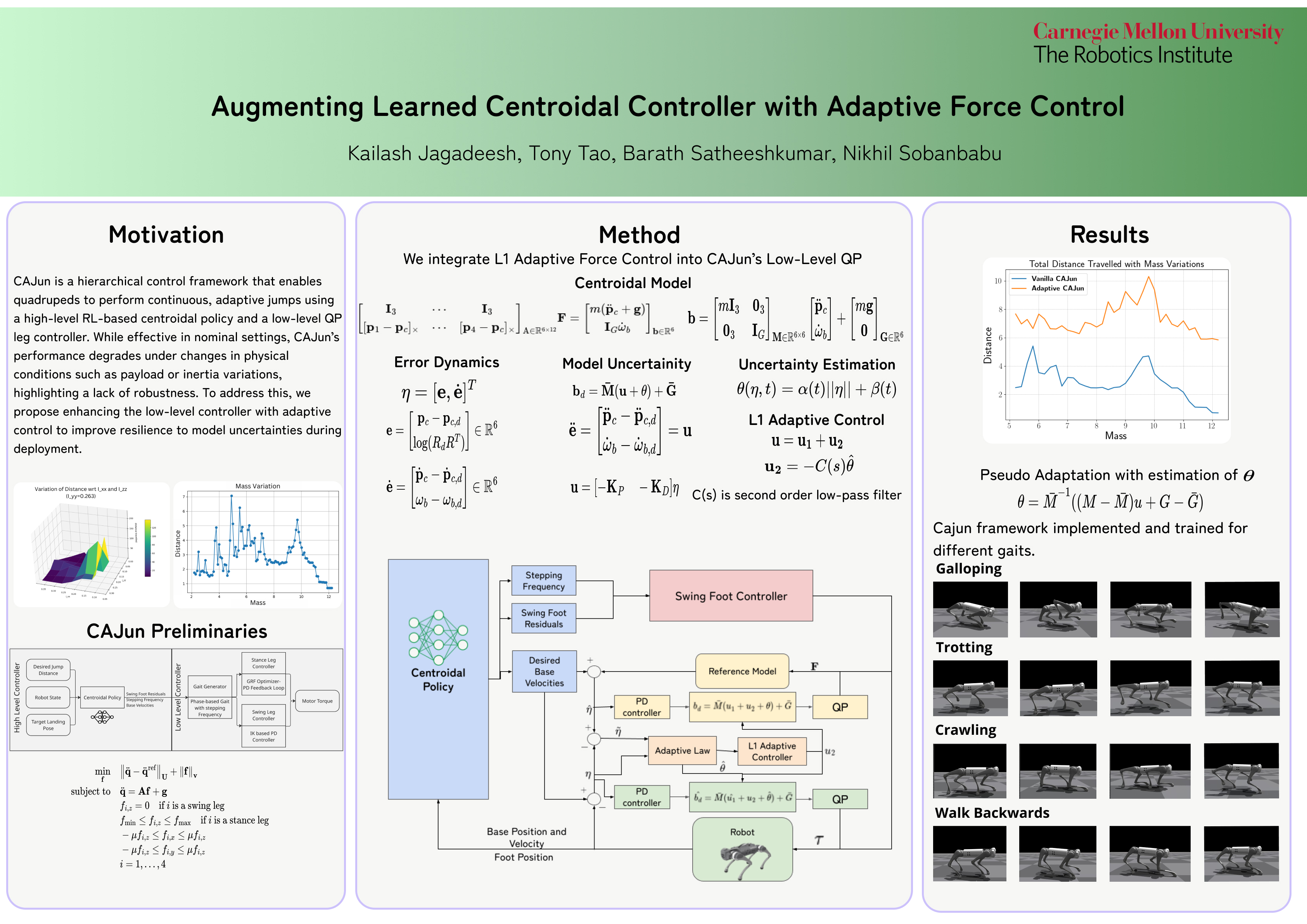
Augmenting Learned Centroidal Controller with Adaptive Force Control
OCRL Project (Spring 2025) Nikhil Sobanbabu, Kailash Jagadeesh, Tony Tao, Bharath Sateeshkumar Improving Payload Adaptability of CaJun controller by Augmenting it with ℒ1 Adaptive Control. |
|
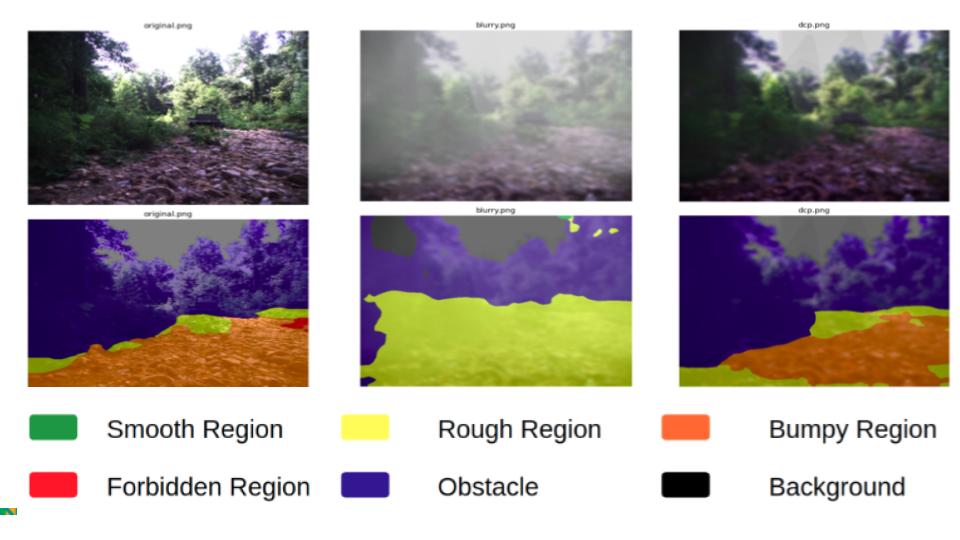
Terrain Traversability Analysis with Image Dehazing
Deep Learning Project (Fall 2024) Nikhil Sobanbabu, Woojin Kim, Ritarka Samanta Investigation of different image dehazing techniques to improve terrain traversability analysis for Autonomous vehicles. |
|
|
Single-Pursuer Multiple-Evader Target-Guarding-Game
Optimal Strategies found for a 1vn game by solving the HJI-PDE equation for a 1vn game with a reach-avoid objective. |
|
|
Multi-agent trajectory tracking for Crazyflie Quadrotors
Coordinated autonomous control of multi-agent quadrotors in a regular polygon formation with varied orientations using the in-built mellinger controller. |
|
|
Control of 5DoF Manipulator of a Mars Rover as part of Team Anveshak
Nikhil Sobanbabu,Shivendra Verma Autonomous control of Manipulator using inverse kinematics and ROS moveit. |
|
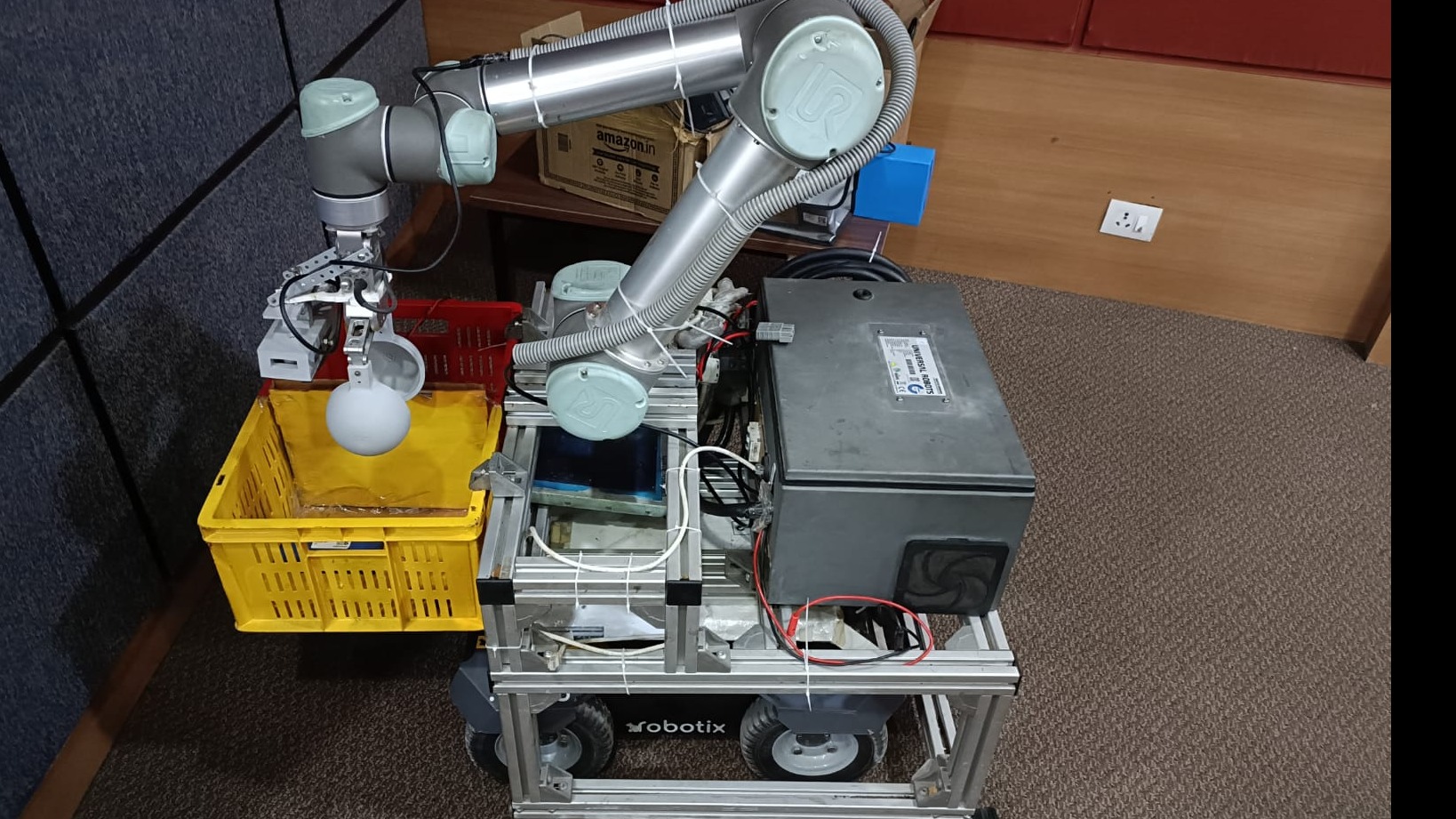
E-yantra Robotics Competition. Theme: Krishi-bot
Nikhil Sobanbabu, Gokul MK Autonomous navigation of an Agricultural robot to identify and pick and place bellpepers inside a greenhouse. |
|
|
Receding-Horizon mode planner for mode planning against perturbations
Nikhil Sobanbabu, Lokesh Krishna Planner chooser behaviours encoded as latent modes using monte-carlo roll outs to be robust against perturbations generating emergent transitions between modes/behaviors. |
|
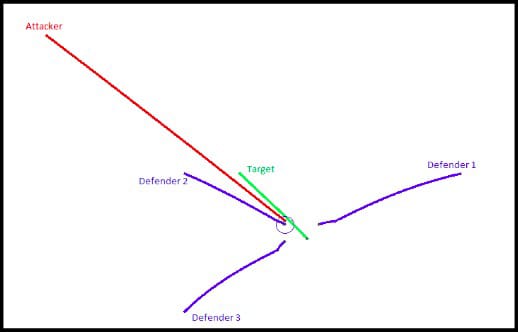
Multi-agent Game Theoretic Framwork for Target-Attacker-Defender game
Nikhil Sobanbabu, Shivendra Verma Simulation environment for the single attacker, singe target, multiple defender pursuit evation differntial game. |
|
|
Swing-up and Stabilisation of inverted pendulum.
Course EE6415 Non-Linear System Analysis Swing-up is done using a control from an energy based Lyapunov function. After a reaching an appropriate angle, pole-placement based stabilisation kicks in. |
|
|
Motion planning for a KUKA mobile Manipulator
Course ED5215 Intro to Motion Planning Nikhil Sobanbabu, Balaji R, Kanishkan M S
Problem Statement: Optimal pick and place of multiple objects to a given destination with payload constraints for the mobile manipulator.
|
Fun Mini-Project |
|
|
Why WASD when you can play minecraft with ESP32 |
Miscellaneous |
|

|
Tech and Innovation Fair, coordinator 2022.
Flagship event of Shaastra, IITM's Technical festival for the year 2022. Participants convert a prototype to a minimum viable product. |
|
|
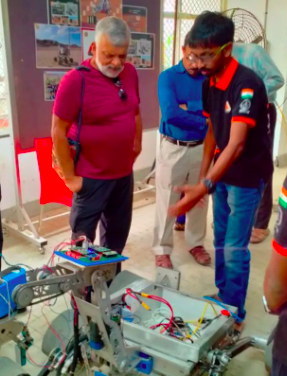
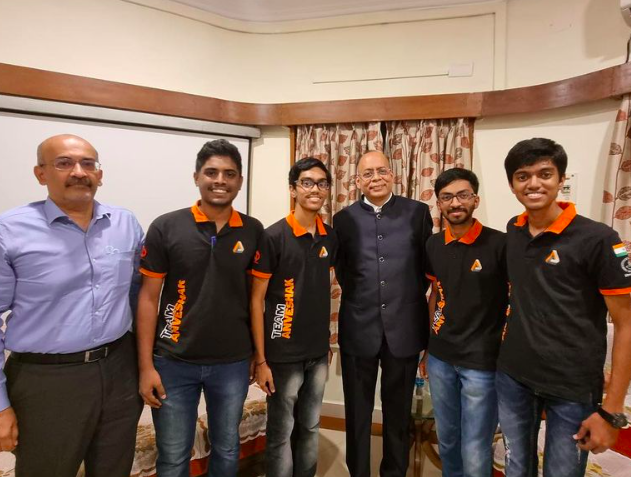
| Discussion with Bob-Balram (Chief Engineer of Ingenuity Helicopter) | Former Indian Defence Secretary, Ajay Kumar |
|
|
Template from jonbarron. |